 OntarioGrapes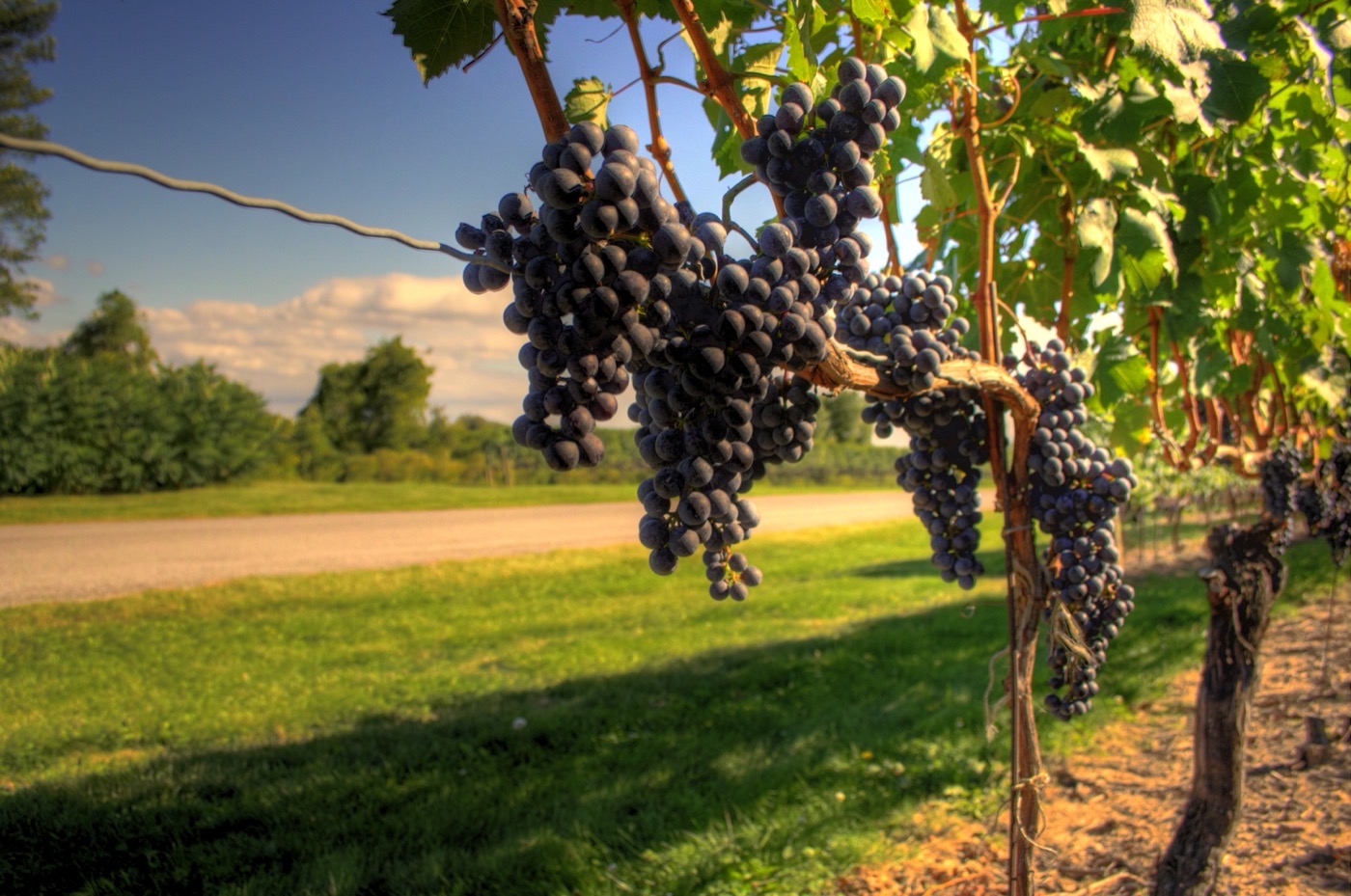
Grape varieties
The grapes grown in Ontario, and why
Ontario's vineyard is a negotiation between what the market wants and what the winter allows. This is the current settlement: which varieties are planted, what each one tolerates, and how the province got here from a century of Concord.
The three families
Every grape in an Ontario vineyard belongs to one of three groups, and the groups matter more than the individual varieties for understanding the province.
Vitis vinifera is the European wine grape: Riesling, Chardonnay, Cabernet Franc, Pinot Noir and the rest of the names on a wine list. It makes the wines the world recognises and it is the least cold-hardy of the three. Vinifera buds begin to die at temperatures somewhere between about minus twenty and minus twenty-five degrees Celsius, depending on variety and on how well the vine hardened off in autumn, and every Ontario region can reach those temperatures in a bad winter. Roughly two thirds of the Ontario vineyard is now vinifera.
French-American hybrids were bred in France in the late nineteenth and early twentieth centuries by crossing vinifera with native American species, originally to resist the phylloxera louse. They inherited hardiness and disease resistance from the American side and enough wine quality from the vinifera side to be worth growing. In Ontario the important ones are Vidal Blanc, Baco Noir, Marechal Foch and Seyval Blanc. They survive winters that kill vinifera and they carry a faint flavour that vinifera does not, which is why they were pulled out in favour of vinifera wherever the climate permitted and kept where it did not.
Native American varieties, chiefly Vitis labrusca and its offspring Concord and Niagara, are the grapes Ontario grew for its first hundred years. They are extremely hardy and productive, and they taste of grape juice, which is what most of them are now used for. The remaining labrusca acreage supplies the juice and jelly market and is a small share of the whole. Catawba belongs to the same family and to the same century here, but it is no longer part of the province's commercial crop: it appears neither in the Grape Growers of Ontario price schedule nor in the fresh-grape acreage returns.
The white varieties
Riesling is the vinifera Ontario grows best and the one most closely tied to its identity. It is among the hardiest vinifera, it ripens in a cool season while keeping the acidity that defines it, and it responds to the limestone-influenced soils of the Niagara benches. It is also the premium icewine grape. Plantings are concentrated on the Beamsville and Twenty Mile benches and in Prince Edward County.
Chardonnay is the most widely planted white vinifera, grown in every region and in every style from lean and unoaked to full and barrel-fermented. It buds early, which exposes it to spring frost, and it is moderately hardy. Prince Edward County has made it a specialty.
Vidal Blanc is the province's most important hybrid and its icewine backbone. Thick-skinned, loose-clustered, rot-resistant and hardy, it does exactly what a grape that must hang into January needs to do. Some is made into dry and off-dry table wine, but its reason for existing in Ontario is the icewine page.
Gewürztraminer, Pinot Gris, Sauvignon Blanc and Pinot Blanc are planted in smaller quantities. Gewürztraminer is hardy and suits the cooler sites; Sauvignon Blanc is the most tender of the group and is confined to the warmer ones. Smaller still, and almost unseen on a wine list, is Auxerrois, which the province pays more per tonne than Riesling.
Alongside the wine grapes, Ontario grows a small crop of fresh-eating table grapes — about 342 acres in all, nearly nine tenths of it a single variety.
The red varieties
Cabernet Franc is Ontario's leading red vinifera because it is the hardiest of the Bordeaux family and ripens a fortnight ahead of Cabernet Sauvignon. It is grown in every region, makes the province's most consistent red wine, and doubles as the main red icewine grape.
Pinot Noir is the fashionable one, cool-climate by nature, well suited to the benches and to Prince Edward County, but tender in winter and temperamental in a wet harvest. It is grown for both still wine and, increasingly, sparkling.
Merlot is widely planted on the warmer Niagara-on-the-Lake plain and along the Lake Erie North Shore. It ripens reliably there and it is one of the more winter-sensitive varieties in the province, so its distribution follows the warmest ground.
Gamay has become an Ontario specialty almost by accident: it is hardy, it ripens early, and it makes a bright, drinkable red in years when the heavier varieties struggle. Ontario is now one of the few places outside Beaujolais where it is taken seriously.
Cabernet Sauvignon and Syrah need the full length of the warmest sites, principally the Lake Erie North Shore and the Niagara River and Four Mile Creek sub-appellations, and even there they are a vintage-dependent proposition.
Baco Noir and Marechal Foch are the hybrids that stayed. Both are very hardy, both ripen early and both make deeply coloured, robust reds with a loyal domestic following. They are planted in the coldest sites and in older vineyards, and they have a small but real place on Ontario shelves that vinifera has never displaced.
Two more reds are worth knowing about for what they are not. Zweigelt was bred in Austria for exactly this kind of climate, is priced here in the same class as Gamay, and has never been planted in quantity; Chambourcin is the one hybrid the regulation holds to a vinifera's ripeness bar. Both illustrate that what Ontario grows is decided at least as much on the shelf as in the vineyard.
Every variety, in detail
Each variety below has its own page, built on the same three official sources: the Grape Growers of Ontario processing price schedule, which shows what the province actually pays per tonne and so what is genuinely grown; the Agri-Metrics acreage study, which ranks the varieties by planted area and its direction of travel; and Appendix A of the VQA regulation, which sets the minimum ripeness each variety must reach. Where a figure is not published for a variety, the page says so rather than estimating.
White varieties
- Vidal first by acreage; the icewine grape
- Chardonnay second by acreage; the widest appellation gap
- Riesling third by acreage; the lowest ripeness bar
- Pinot Gris best-selling white; highest paid
- Sauvignon Blanc the tender one, on the warmest ground
- Gewürztraminer shrinking fastest of the top twenty
- Seyval Blanc Vidal's price class, without the icewine
- Chardonnay Musqué a clone the rules treat as a variety
- Auxerrois well paid, barely planted
- Pinot Blanc paid like Pinot Gris, planted like an afterthought
- Muscat Ottonel a bar the rules never raise
- Viognier a named line for a rare grape
- Kerner named by its own parentage
Red varieties
- Cabernet Franc fourth by acreage, thirteenth by sales
- Merlot the highest ripeness bar in the rules
- Pinot Noir second most expensive; increasingly sparkling
- Cabernet Sauvignon flat for five straight years
- Baco Noir the hybrid that outsells every vinifera red
- Gamay Noir a specialty acquired by accident
- Syrah the most expensive grape in the province
- Marquette fastest-growing variety in the top twenty
- Chambourcin a hybrid held to a vinifera's bar
- Maréchal Foch Baco's contemporary, without the market
- Zweigelt bred for this climate, barely planted
- Petit Verdot Merlot’s price, a far lower bar
- Dornfelder bred to fix a colour problem
Juice and heritage grapes
- Concord outside the wine rules entirely
- Niagara the white labrusca, and a name collision
- De Chaunac legal in the wine, banned from the label
Table grapes
- Sovereign Coronation 87% of the province's table-grape acreage
- Fredonia, Himrod and the rest the other 45 acres
What decides the mix
A grower choosing what to plant in Ontario is balancing four things, and winter hardiness is the one that cannot be negotiated away. The others are the length of the season the site offers, which determines whether a late variety will ripen; the site's drainage and frost exposure, which decide how early a variety can safely bud; and the market, which decides what the grapes will sell for. The result is a strong pattern across the province. The warmest sites, on the Lake Erie North Shore and along the Niagara River, carry the tender late reds. The benches carry Riesling, Chardonnay and Pinot Noir. The coldest sites, in Prince Edward County and outside the appellations, carry the hardiest vinifera and the hybrids, and in the County the vinifera are buried every autumn to survive at all. Beyond the designated areas altogether — in Norfolk County, for instance — hardiness decides everything, because no appellation is available to serve. The climate page puts numbers to those temperatures.
How the vineyard was replanted
Until the late 1970s the received wisdom was that vinifera could not survive an Ontario winter, and the province's vineyards were planted almost entirely to labrusca and hybrids. A few growers in Niagara proved the wisdom wrong through the 1970s and early 1980s, with Riesling and Chardonnay first and then reds, and their success made the rest of the industry's plantings look like a liability. The Canada-US Free Trade Agreement of 1988 removed the tariff protection under which labrusca-based wine had been sold, and the federal and provincial governments funded a programme that paid growers to pull out low-value vines and, if they chose, replant to varieties the new market would buy. A large share of the province's labrusca acreage disappeared within a few years. The vinifera share has climbed steadily since, and the modern Ontario vineyard, two thirds vinifera and specialising in the cool-climate varieties that do best here, is the product of that generation's decision. The history page covers the pull-out and what led to it.
Rootstocks and clones
Almost all vinifera in Ontario is grafted onto rootstocks, both because phylloxera is present and because rootstock choice affects vigour, ripening date and, to a degree, cold tolerance. The graft union is the vine's most vulnerable point in winter, which is why growers hill soil over it in autumn and why a winter that kills the top of a vine may spare the root and allow it to be retrained. Clone selection within a variety matters too, particularly for Pinot Noir and Chardonnay, and the sparkling-wine clones of both have followed the growth of that category. The research bodies on the resources page publish the current trial results.
The original ontariograpes.com carried a page on the variety trials and monitoring programmes the Viticultural Roundtable ran in Essex County in the early 2000s. That address now redirects here.