 OntarioGrapes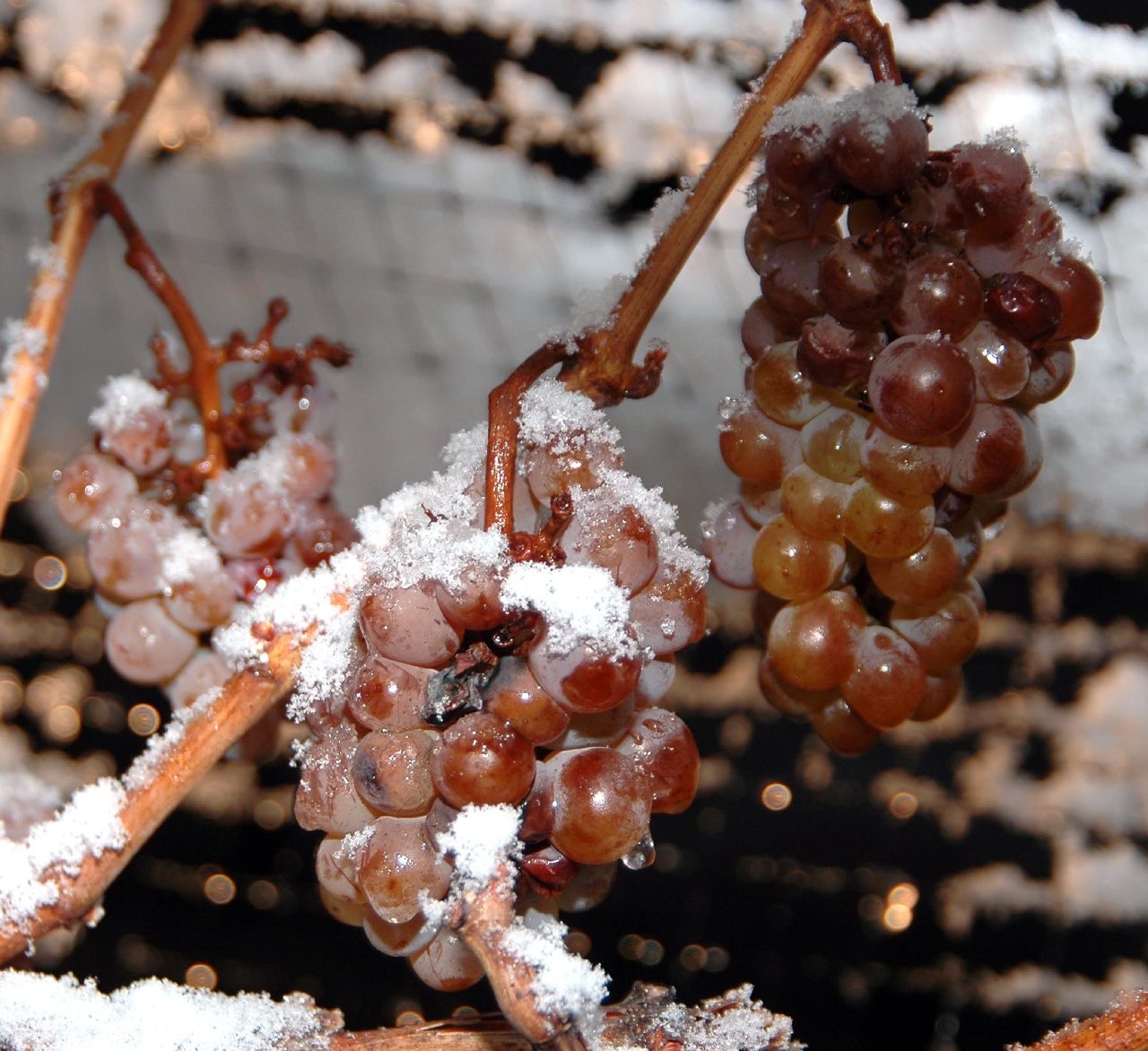
Icewine
Ontario icewine: how it is grown, harvested and regulated
A wine made by leaving the grapes on the vine until winter freezes them solid, then pressing them frozen. Ontario makes more of it than anywhere else in the world, and the reasons are climate, law and a great deal of cold labour.
What icewine is
Icewine is made from grapes that have frozen naturally on the vine. When a frozen grape is pressed, the water in it stays behind as ice and only a small quantity of highly concentrated juice runs off: intensely sweet, intensely acidic, and carrying everything the grape had in it. That juice is fermented, slowly, into a wine that is sweet but not heavy, because the acidity that was concentrated along with the sugar holds it up.
The method was developed in Germany, where it is called Eiswein and where the cold required to make it arrives only occasionally. In Ontario the cold arrives every year. That difference, more than anything else, is why a German curiosity became an Ontario industry.
The rules
In Ontario the word icewine on a label is regulated under the VQA standard, and the rules exist because the product is easy to fake and expensive to make honestly. The essentials:
- The grapes must freeze naturally on the vine. Artificial freezing of grapes or juice is prohibited; wine made that way cannot be called icewine.
- Harvest and pressing must take place at minus eight degrees Celsius or colder. Growers register their intention to make icewine in advance and the picks are subject to verification.
- The juice must reach a minimum sugar concentration of 35 degrees Brix at pressing, a level that unfrozen grapes cannot reach, with a minimum average across the pressing run as well.
- Nothing may be added to increase sugar, and the finished wine must meet minimum residual sugar and alcohol standards.
- The grapes must be from approved varieties grown within the appellation named on the label, and the wine must pass VQA's tasting and laboratory panels like any other.
The exact thresholds and procedures are set out in the VQA Ontario regulations, linked from the resources page. They are what makes the word mean something.
The grapes
Three varieties account for nearly all Ontario icewine.
Vidal Blanc is the workhorse. A French-American hybrid, it has thick skins that resist rot and splitting through the long autumn hang, loose clusters that dry rather than mould, and buds hardy enough to survive the winter that follows the harvest. It also holds its acidity, which matters when the sugar is being concentrated three-fold. Vidal icewine is the classic Ontario style: apricot, honey and tropical fruit, with a clean acid line. No other hybrid grown here does the job: Seyval Blanc shares Vidal’s price class and its hardiness but not its skins, and cannot be hung to January.
Riesling is the aristocrat. It is harder to grow for icewine, because it is more prone to rot and its yields are lower, but its acidity is higher still and its aromatics are more complex, and Riesling icewine ages for decades. It commands a premium and is made in smaller volumes.
Cabernet Franc is the red. Ontario growers were among the first to make red icewine at scale, and Cabernet Franc's combination of cold hardiness, thick skin and red-fruit flavour made it the obvious candidate. Smaller quantities are made from other red varieties and from Gewürztraminer and Chardonnay.
In the vineyard
An icewine block is farmed differently from the start of the season. The grapes are left on the vine when the rest of the vineyard is picked in September and October, and from that point the grower's job is to keep them there. The vines are netted, entirely, because the flocks of starlings and robins that pass through Ontario in autumn will strip an unprotected block in an afternoon. The netting stays on for two or three months. The grapes lose water and shrivel, the acidity softens slightly, and some fruit is lost to rot, to wind and to animals whatever the grower does. A quarter to a third of the crop that was on the vine in October is gone by the time the cold comes.
Then the waiting. Minus eight is a hard threshold, and a December that hovers at minus five is a December of lost sleep. The first qualifying cold typically arrives between mid-December and mid-January; in a warm year it may not arrive until February, by which time more of the crop has been lost, and in a very warm year it does not arrive at all and the block is written off. When the forecast finally shows a hard night, crews are called for the small hours, because the temperature is coldest just before dawn and the grapes must be pressed while still frozen. Icewine harvest is done by hand, in the dark, often in wind, by people wearing everything they own.
In the press
Frozen grapes are pressed hard and slowly, and the yield is tiny. Where a tonne of grapes picked in October gives something like six or seven hundred litres of juice, the same tonne pressed frozen gives perhaps a hundred to a hundred and fifty, the rest staying behind as ice. The juice is so concentrated that yeast struggles in it; fermentation is slow, often taking months, and stops on its own well short of dryness, leaving the residual sugar that defines the wine. The finished alcohol is modest, usually between nine and eleven percent.
The arithmetic
The economics explain the price on the shelf. Start with a block that would have produced a normal crop in October. Lose a quarter to a third of it hanging. Press what remains at a fifth of the normal juice yield. Ferment it for months in tank space that a table wine would have vacated by Christmas. Add the netting, the night-time labour and the risk that in one year in every several the crop is lost entirely. The result is that a vineyard produces roughly a tenth of the volume of wine it would have as a table wine, and it is sold in half bottles. Icewine is not expensive because it is fashionable; it is expensive because the vineyard is.
How Ontario came to lead
The first commercial Ontario icewines were made in the early 1980s by a handful of Niagara producers experimenting with the German method, and for the first few years they were curiosities sold to visitors. The turning point came in 1991, when an Ontario Vidal icewine won a top award at Vinexpo in Bordeaux and the international trade noticed that a country it associated with cold could turn the cold into something. Through the 1990s icewine became the export product that introduced Ontario wine to Asia, where the style found its strongest market, and the volume grew until Ontario was producing more icewine than Germany and Austria combined. Today it remains the province's most recognised wine abroad and the one product for which the Ontario climate is not a handicap to be managed but the point.
Reading the label
A genuine Ontario icewine will carry the VQA symbol and the word icewine, and an appellation of origin. Products labelled "icewine style", "iced wine", "dessert wine made from frozen grapes" or anything similar are not icewine under the standard, and are usually made by freezing grapes or juice in a freezer. They can be pleasant. They are a different thing, and the price difference tells you which is which.
This page lives at the same address the original ontariograpes.com used for its icewine page in the early 2000s. The old page was a short note for growers on the Lake Erie North Shore about netting and harvest timing; this one is written fresh, but links to the old address still arrive here.