 OntarioGrapes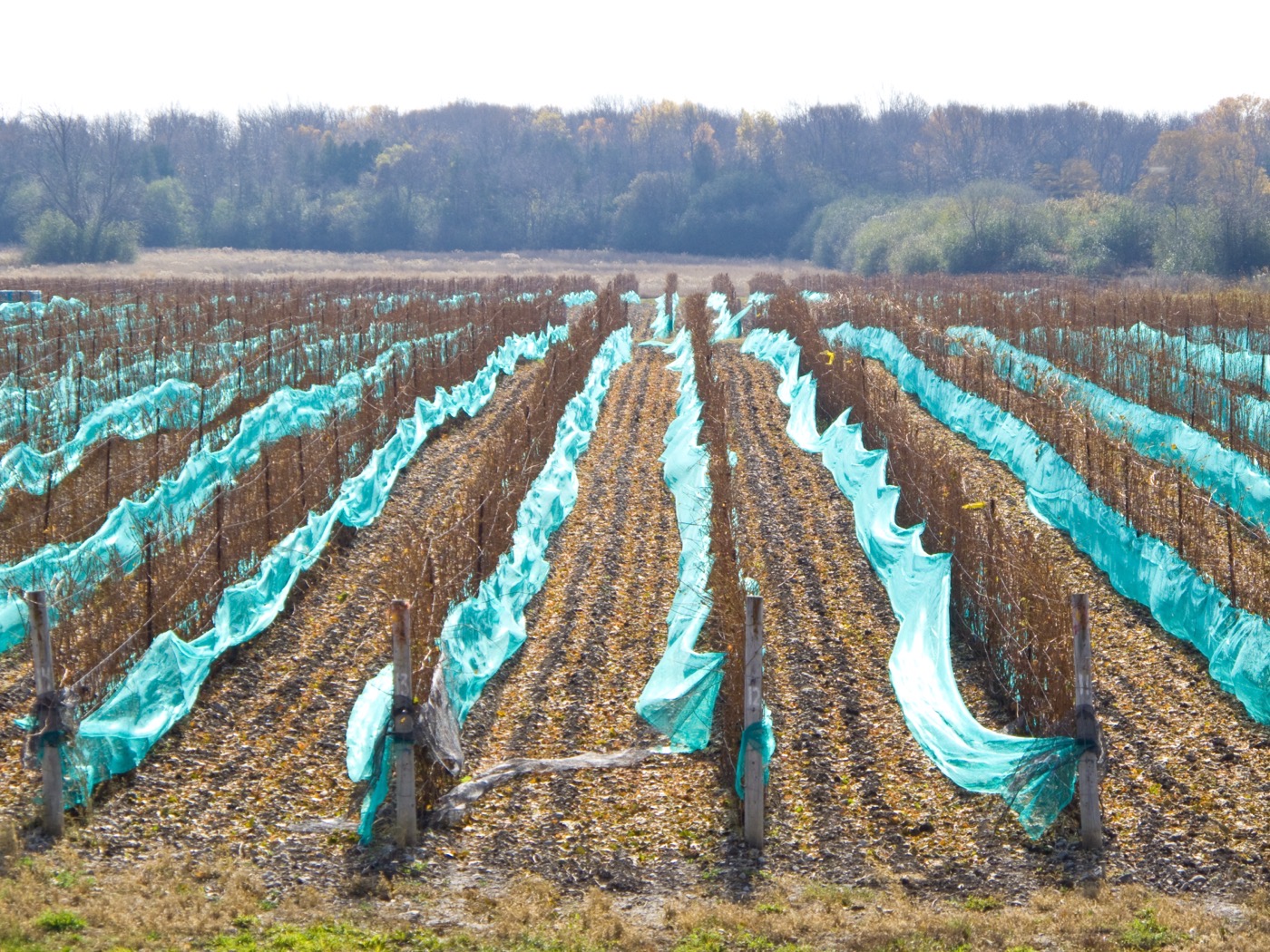
History
A history of grape growing in Ontario
From a winery on an island in Lake Erie in 1866 to a regulated appellation system a century and a third later, by way of a hundred years of Concord and a government programme that paid growers to tear it out.
Before the vineyards
Wild grapes grew in southern Ontario long before anyone cultivated them, and the riverbank vines of Vitis riparia were noted by early European travellers. Settlers made wine from them and from imported cuttings from the late eighteenth century, but as a household craft rather than a trade. Ontario's first recorded commercial vineyard is usually placed in the 1810s near what is now Cooksville, in the Toronto area, but it was a small affair and it did not last.
Pelee Island, 1866
The industry's founding date is 1866, when three investors from Kentucky, having noticed that Pelee Island in Lake Erie shared the latitude and the lake climate of the Ohio vineyards they knew, bought land there, planted grapes and built a winery they called Vin Villa. It was the first commercial winery in Canada, and within a few years a second, larger operation was running on the island alongside it. Pelee Island and the Essex County mainland opposite were the centre of Ontario grape growing for the rest of the nineteenth century, and the stone ruins of Vin Villa still stand. The island's claim to be the birthplace of Canadian wine is the reason the Lake Erie North Shore calls itself the oldest commercial grape region in the country.
The move to Niagara
Through the last decades of the nineteenth century vineyards spread along the Niagara Peninsula, where the combination of Lake Ontario and the Escarpment gave growers a more reliable winter than Essex County's, and where the growing market of Toronto and Hamilton was close. By 1900 Niagara had overtaken the southwest, and the balance has never shifted back. The grapes were almost entirely native American varieties and their crosses, Concord and Niagara above all: hardy, productive and suited to the sweet and fortified wines the market of the day wanted.
Prohibition and its long shadow
Ontario prohibited the sale of alcohol from 1916 to 1927, with one exception that shaped the industry for fifty years: wine made from Ontario grapes could still be sold. The result was a boom in licensed wineries, dozens of them, many producing wine of dismal quality from whatever grapes were available, and a consumer habit of sweet, strong, cheap domestic wine that outlived Prohibition itself. When the province reopened the trade in 1927 it froze the number of winery licences, and the industry consolidated around a handful of large houses, Brights and Jordan the best known, making fortified and sparkling wines from labrusca and hybrid grapes — above all Concord, Niagara and De Chaunac, the hybrid red that dominated the province's plantings before the pull-out and that the regulation now bars from appearing on a label. The grape growers organised themselves in 1947 into what is now Grape Growers of Ontario to negotiate prices with those houses, and for a generation the arrangement was stable and unambitious.
The vinifera pioneers
The received view in the industry through the 1960s was that European wine grapes could not survive an Ontario winter, and the large houses had no commercial reason to test it. The testing was done at the margins. Brights itself had planted experimental vinifera and hybrids under its French winemaker from the 1940s, and by the 1950s it was making small quantities of Chardonnay. In the 1970s a new generation of small growers and would-be winemakers in Niagara planted Riesling, Chardonnay and then red varieties in earnest, and the province issued its first new winery licence since Prohibition in 1975, to a small estate that had staked itself on vinifera. Through the early 1980s the estate wineries multiplied, their wines began to win attention, and the gap between what the land could do and what the industry was doing became impossible to ignore.
Free trade and the pull-out
What forced the change was trade policy. Ontario's wine industry had been protected for decades by listing and pricing rules that favoured domestic wine in the provincial monopoly stores. The Canada-US Free Trade Agreement, negotiated in 1987 and in force from the beginning of 1989, together with a parallel ruling against those practices under the international trade rules of the day, meant the protection had to go, and everyone understood that labrusca-based wine could not compete without it. The federal and provincial governments responded with a Grape Acreage Reduction Program that paid growers to remove vines, and a large share of the province's labrusca and low-value hybrid acreage was pulled out within a few years. Growers who stayed in replanted to vinifera and to the better hybrids. It was brutal for the people it happened to and it is the reason the modern industry exists.
VQA
In the same years the estate wineries and the growers established the Vintners Quality Alliance, in 1988, as a voluntary standard: a definition of what a wine had to be to call itself Ontario wine, with approved varieties, minimum ripeness, a tasting panel and, over time, appellations of origin. It was what the pull-out was for: an industry that had replanted to vinifera needed a way to tell the consumer that its product was now different. The standard was given force of law by the province in 1999 and administered by VQA Ontario, the appellation authority, from 2000. The appellation map was redrawn and extended in 2005, when Niagara's sub-appellations were defined, in 2007, when Prince Edward County was recognised, and in 2015, when the South Islands became a sub-appellation of the Lake Erie North Shore. The regions page describes the result.
Icewine and the world
The one product that carried the new Ontario abroad was icewine. First made commercially in Niagara in the early 1980s, it won a major international award in 1991 and became, through the 1990s and 2000s, the province's export calling card and its introduction to the Asian market. It also demonstrated something the pull-out generation had bet on: that the Ontario climate could be a distinction rather than only a constraint. The icewine page tells that part of the story.
Where it stands
The Ontario vineyard today is around two thirds vinifera, concentrated in cool-climate varieties, organised into three appellations, and farmed by several hundred growers on the order of seventeen thousand acres. It is a small industry by world standards and a young one by the standards of the places it is compared with, and it carries a longer history than most people assume, most of it in grapes it no longer grows. The statistics page gives the current numbers and where to find them.