 OntarioGrapes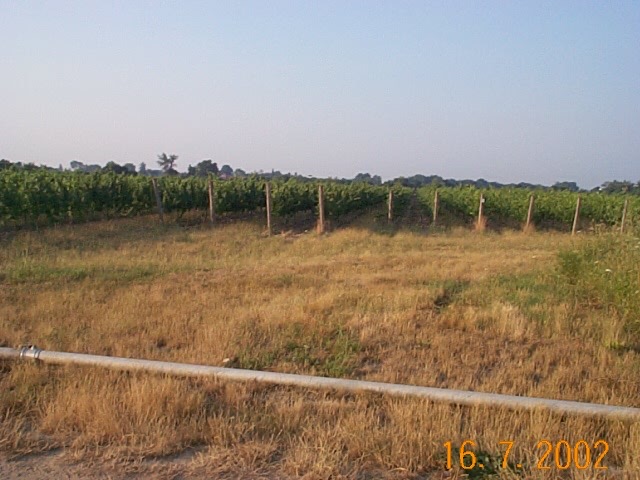
Lake Erie North Shore
Lake Erie North Shore and Pelee Island
Canada's southernmost vineyards, its oldest commercial wine region, and the corner of Ontario this site was first written from. Warm, exposed, and still arguing with Lake Erie about the winter.
Where it is
The Lake Erie North Shore appellation covers the vineyards of Essex County, the peninsula at the far southwestern tip of Ontario that reaches down between Lake Erie and Lake St. Clair towards Detroit, together with the islands of Lake Erie that belong to Ontario. The mainland vineyards cluster along the lakeshore from Amherstburg east through Harrow, Colchester and Kingsville towards Leamington, mostly within a few kilometres of the water. Pelee Island lies about twenty kilometres offshore, and with the eight smaller islands of the Township of Pelee it forms the South Islands sub-appellation, recognised in 2015. Pelee Island is the southernmost inhabited point in Canada; the latitude here is around 42 degrees north, the same as northern California, Rome and the Rioja.
The climate
Lake Erie is the shallowest of the Great Lakes and the warmest in summer, and the land along its north shore has the longest and warmest growing season in Ontario. Heat accumulation is higher than anywhere in Niagara, the frost-free season on the islands exceeds two hundred days, and the late-ripening red varieties that are a gamble on the Niagara benches, Cabernet Sauvignon, Merlot and Syrah, ripen here with some regularity. The terrain is nearly flat and the soils are mostly sandy loams over clay, free-draining and quick to warm in spring.
The same shallowness that warms the lake in summer is the region's weakness in winter. In a hard winter Lake Erie freezes across, and when it does the open water that would otherwise take the edge off the coldest nights is gone. The flat land offers little natural drainage of cold air, and there is no Escarpment to set up the circulation Niagara relies on. Winter injury to vinifera is therefore a real and recurring hazard, and it is the reason the region's growers have always watched the winter as closely as the growing season. Pelee Island, surrounded by water on every side, gets more moderation than the mainland and has the longest season of all.
The grapes
The region's reputation rests on its reds. Cabernet Franc, Merlot and Cabernet Sauvignon are the core, with Syrah in the warmest sites, and the Bordeaux blend is the regional signature. Among whites, Riesling, Chardonnay, Pinot Gris and Sauvignon Blanc are grown, and Vidal for icewine. Because of the winter risk, hardy hybrids have persisted here longer than in Niagara, and Baco Noir and Vidal still have a place. The varieties page covers what each tolerates.
The history
This is where Canadian commercial winemaking began. In 1866 three investors from Kentucky, who knew the Ohio vineyards on the opposite shore, planted vines on Pelee Island and built the Vin Villa winery, the first commercial winery in Canada. A second and larger operation followed on the island, and the Essex mainland planted alongside. Through the later nineteenth century the region was the centre of Ontario grape growing, before Niagara's more reliable winters and closer markets drew the industry east. The island's vineyards dwindled through the twentieth century and Vin Villa fell into ruin; its stone walls still stand.
The modern region dates from the late 1970s and 1980s. Pelee Island was replanted to vinifera from 1979, and its winery, on the mainland at Kingsville, opened a few years later and grew into one of the largest estate wineries in the country. On the mainland the first of the new wineries opened at Harrow in 1980, and a handful more followed through the decade. The regional growers and vintners organised as the Southwestern Ontario Vintners Association in 1993, which became EPIC Wineries, for Essex Pelee Island Coast, in 2012. The appellation was recognised under VQA in the 1990s and the South Islands sub-appellation in 2015.
The roundtable
Between those two organisations there was a period when much of the practical exchange among the region's growers happened informally, and one expression of it was the Viticultural Roundtable of Southwestern Ontario, whose web page lived at this address from 2000 to about 2008. The roundtable described itself as a forum for discussion and the sharing of expertise among grape growers in the southwest, and its site listed its variety trials and monitoring programmes, its calendar of meetings, notes on icewine and winter, a page of local statistics and a list of resources. It was a volunteer effort by people who were farming the region while they wrote about it. The current site is written fresh and covers the whole province, but this page keeps the region the roundtable served at the centre of the map, and the old addresses redirect to the pages that now cover the same subjects. The about page has the rest of that story.
Visiting
The region's wineries are strung along the lakeshore roads between Amherstburg and Leamington, with the greatest concentration around Harrow and Colchester, and are reached from Windsor in under an hour. Pelee Island is served by ferry from Leamington and Kingsville through the warmer months, with a much reduced service and a small aircraft in winter, and the island's winery pavilion, its nature reserves and the Vin Villa ruins make it a day trip rather than a stop. The regional association publishes the current winery list and event calendar, and is linked from the resources page.
This page stands where the original site's location page did. The old page described the region for growers and linked to two of the early estate wineries; those links have not been carried over, and no winery is endorsed here.